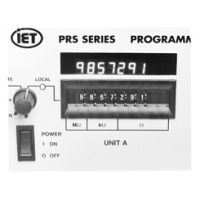
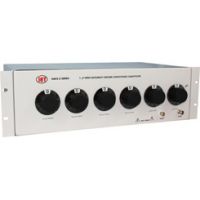
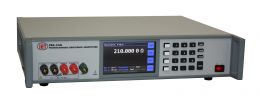
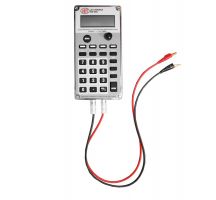
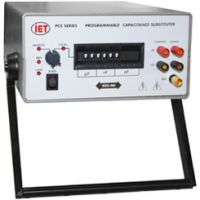
- IEEE, RS232 or Ethernet Programmable Decade Resistor
- Wide range and resolution: 100 mΩ to 100 M&Omega with 1 mΩ resolution
- Available at accuracies of : 0.01%, 0.02%, 0.05%, 0.1%, 0.5%, and 1%
- Special RTD and custom configurations
- Dual / Combo rackmount models ( examples: Resistance & Capacitance or Resistance & Inductance)
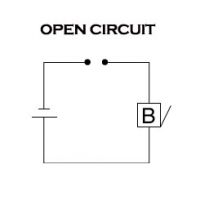
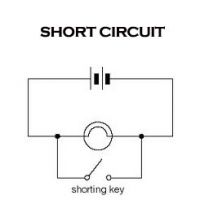
- Programmable "open circuit" and "short circuit" states optional
- Desktop and 19" Rackmount enclosures
- Contact us for Custom or Built to Order Models
- High power versions available
You should strongly consider our NEW PRS-330 Decade Resistor See PRS Selection Guide for all Programmable Decade Resistors
Reasons to still consider the PRS-200 Series
- If you can accept a 0.1% or 1% unit. The PRS-200 and PRS-201 have an upfront cost of 30-40% less than the PRS-330. The PRS-202 is similarly priced or more expensive than the PRS-330
- Maximum Resistance: The PRS-200 series can have a maximum resistance of 100 MΩ vs the PRS-300 series which has a maximum resistance of 20 MΩ
- High Power: The PRS-202 series can be custom built to your application allowing for higher power or custom requirements Contact info@ietlabs.com for more information
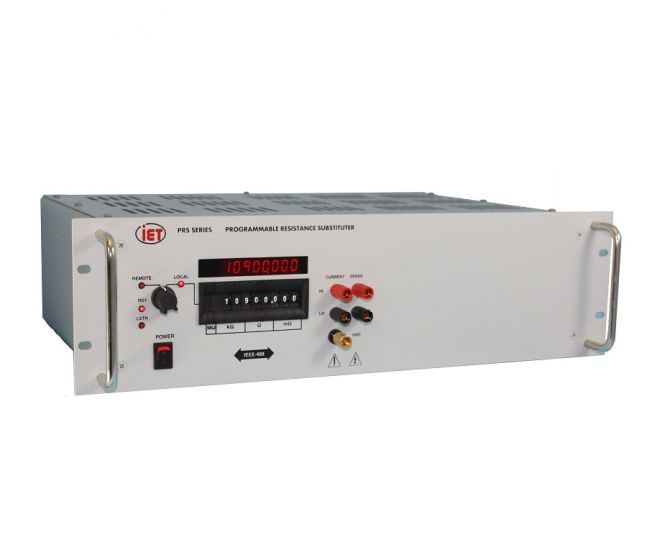
The PRS Series is a broad line of high programmable decade boxes. They provide direct resistance substitution as well as RTD (Resistance Temperature Detector) simulation, in a wide selection of ranges, tolerances and ratings.
The PRS programmable resistance decade box is a precision resistance source with excellent characteristics of stability, temperature coefficient, and power coefficient. High dynamic ranges are available, starting as low as 1 mΩ, and extending to as many as 10 decades. These features combined with a low virtually constant zero resistance make for very versatile instruments.
The PRS Series programmable resistance decade box features two optional special settings. An "open circuit" and a "short circuit". These modes are useful for obtaining reproducible transitions between settings, i.e. break-before-make or to short between settings. The "short circuit": setting also provides a reduced zero resistance.
Operation is both local using convenient direct-reading front panel thumbwheel switches, and remote with optional Ethernet, RS-232, or IEEE-488 interfaces.
Both can provide an optional extra "10" position for each decade.
The PRS Series programmable resistance decade box employs very low resistance, low thermal emf relays with gold-clad silver-alloy contacts. A special design keeps contact resistance to a minimum. The gold plating keeps the silver contacts from becoming tarnished when unused, or when only low currents are passed through them. This is most often the case when only minute test currents are drawn by digital multimeters and other test instruments. Contact resistance remains low and repeatable.
The programmable decade box employees, high-quality gold-plated tellurium-copper five-way binding posts serve to minimize the thermal emf effects, which would produce errors in dc resistance measurements. All other conductors within the instrument, as well as the solder employed contain no metals or junctions that could contribute to thermal emf problems.
With a resolution as low as 1 mΩ and a maximum available resistance of over 100 MΩ, the PRS Series Series may be used for exacting precision measurement
applications requiring high accuracy, good stability, and low zero resistance. They are suited for automatic and manual calibration and testing, simulation of RTD'S, programmable loads, and many other laboratory and industrial applications. The PRS Series programmable resistance decade box may be rack mounted to serve as components in measurement and control systems.
PRTD Version: Low resistance versions with a fixed minimum resistance setting (4 Ω or specified by customer) are suitable for Programmable RTD (Resistance Temperature Detector) simulations. This design virtually eliminates the effect of zero resistance and relay contact resistance, providing the specified absolute accuracy over its entire range.
DRIVERS - TEST KEYBOARD
To aid the user in operating the PRS/PCS/PLS, Three “Keyboard” Controller programs - the easiest way to control GPIB, RS232 or Ethernet devices without writing a program - are available from IET. This Keyboard programs automatically finds your device at start-up and it lets you enter just the data that you want to send to the device. This program works with ICS, Measurement Computing and National Instruments GPIB controllers.
For GPIB IEEE-488.1 and IEEE-488.2 interface
Download ICS_GPIBkybd_Install.zip
Unzip the file and follow instructions to install. Open the application. You may use the Find Listeners button to confirm that the PRS unit is recognized. Other instruments may also be recognized at this time.
Enter and set the Address to the PRS address. Use the window to send a command string to the PRS, where the command string is constructed as described in the operating manual. A command string might be, for example:
SOURce:DATA resistance string
For Serial RS-232 interface for Windows XP:
Download: ICS_Serkybd_Install.zip
Unzip the file and follow instructions to install. Open the application. Initialize the COM PORT and use the Device Command window to send a command string to the PRS, where the command string is constructed as described in the operating manual. A command string might be, for example:
SOURce:DATA resistance string
Download: Serkybd.net.zip
Unzip the file and follow instructions to install. Open the application. Initialize the COM PORT and use the Device Command window to send a command string to the PRS, where the command string is constructed as described in the operating manual. A command string might be, for example:
SOURce:DATA resistance string A VB.NET 2005 version of the Serkybd program for Windows 7 and later operating systems. COM Port range expanded from 1 to 12 for USB-to-Serial Adapters. For Ethernet interface:
Download:ICS_VXI-11.zip
Unzip the file and follow instructions to install. The application allows the user to change IP address and communicate with the PRS. Please see PRS instruction manual for more information.
BASIC SPECIFICATIONS
(See datasheet for full specifications)Standard Models
| Model | PRS-200 | PRS-201 | PRS-200W | PRS-201W | PRS-202 | PRS-202W | PRTD-X-6-0.001 |
| Type | Resistance | Precision Resistance | Wide Range Resistance | Wide Range Precision Resistance | High Precision Resistance | Wide Range High Precision Resistance | Programmable RTD Simulator |
| Accuracy | 1% +70 mΩ | 0.1%+ 30 mΩ | 1%+ 70 mΩ | 0.1%+ 30 mΩ | 0.05% + 15 mΩ | 0.05% + 15 mΩ | 0.01% + 15 mΩ |
| Decades | 7 | 7 | 9 | 9 | 7 | 9 | 6 |
| Range | 0 - 10 MΩ | 0 - 10 MΩ | 0 - 100 MΩ | 0 - 100 MΩ | 0 - 10 MΩ | 0 - 100 MΩ | 4-1,003.99 Ω |
| Resolution | 1 Ω | 1 Ω | 0.1 Ω | 0.1 Ω | 1 Ω | 0.1 Ω | 0.001 Ω |
| Type of Components | Resistance wire for 0.1 Ω steps and under; metal film for 1 Ω steps and over. | Resistance wire for 0.1 Ω steps and under; wirewound, sealed non-inductive resistors for 1 Ω to 100 kΩ steps;
Precision metal-oxide film resistors for 1 MΩ steps and over | |||||
| Max. Load* | 0.5 A, 200 V (dc + ac peak), 0.2 W/step, 2 W unit, whichever applies first.* | 3 A, 200 V (dc + ac peak), 0.5 W/step, 4.5W/unit, whichever applies first.* | |||||
| Residual Impedance | <450 mΩ | <600 mΩ | <100 mΩ | <140 mΩ (typically <100 mΩ) | Absolute Value | ||
Switching time: < 4 ms per change; < 7 ms for ≤0.05% units
IEEE: GPIB standard 24 pin connector, conforms to IEEE-488.2; SCPI 1994.0 command set; Hardware or software configurable addressing range of 0 to 30. .
RS232: 25 pin male DTE interface conforms to EIA-STD-RS-530; SCPI 1994.0 command set; data rates from 300 to 115200 bps.
Ethernet: Interface conforms to IEEE 802.3 Speeds 10BaseT (10 Mb/s) and 100BaseT (100 Mb/s), IP Address Static or DHCP, Factory setting 192.168.1.254 static.